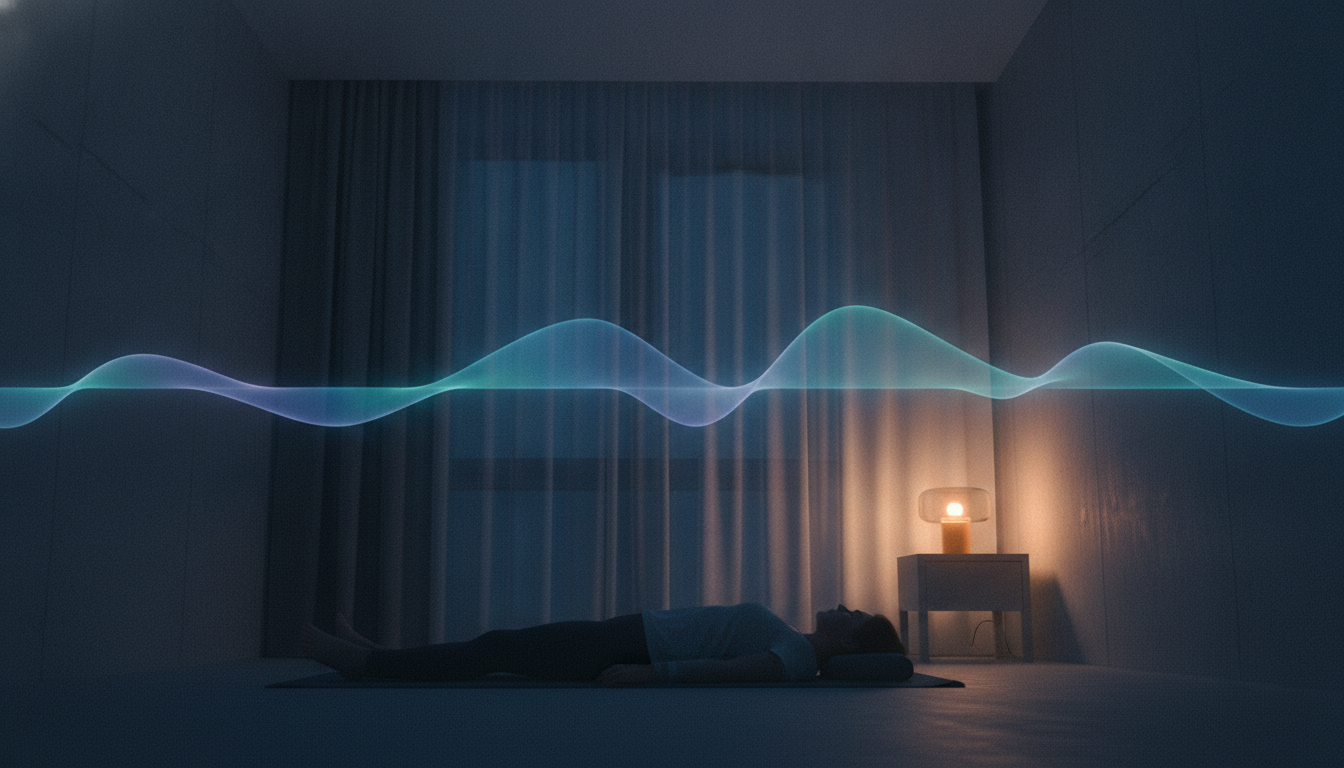
Can yoga nidra help with insomnia?
Yoga nidra may help with insomnia by lowering the pre-sleep arousal that keeps it going, but it is a supportive practice, not a fix. The hard part of insomnia is rarely that you do not want to sleep. It is that lying down flips a switch — the mind starts cataloguing tomorrow, the body stays braced, and the harder you push for sleep, the further it retreats.
That detail matters, because it tells you what a practice would have to do to be useful. It cannot force sleep. Nothing can. What it can do is take pressure off the system that is keeping you awake.
That is the lane yoga nidra plays in. It is a guided lying-down practice that walks you through slow breathing, a body scan, and gentle attention, holding you at the drowsy edge of sleep without demanding that you cross it. The interesting question is not whether it is magic. It is whether quieting that pre-sleep churn actually moves the needle — and how good the evidence really is.
What keeps insomnia going at night?
Insomnia is sustained, in large part, by arousal at the wrong time. Sleep researchers measure two distinct, separable kinds of pre-sleep arousal: cognitive (racing thoughts, worry, planning) and somatic (bodily tension, a heart that will not slow down). Both run high in people with insomnia, and both are exactly what you feel in the dark when sleep will not come.
This is why “just relax” is useless advice but not a useless idea. The two halves respond to different things. Somatic arousal eases with breathing and body-based techniques; cognitive arousal eases when attention has somewhere else to go besides the worry loop. A practice that touches both has a plausible path to lowering the total load.
There is direct evidence that mind-quieting practice can shift this. In one randomized trial in chronic insomnia, the meditation arms dropped an average of 7.13 points on the validated Pre-Sleep Arousal Scale, versus 0.16 for the control group. It is a single, modest study — but it shows the dial is real and can be turned.
How yoga nidra could lower that arousal
Yoga nidra works on both arousal channels at once, which is its mechanistic appeal. The slow, extended exhales and the systematic body scan downshift you toward parasympathetic (“rest and digest”) activity, easing the somatic side. Meanwhile, following a voice through a fixed sequence gives your attention a place to rest other than tomorrow’s to-do list, easing the cognitive side.
Proposed physiological mechanisms line up with this: studies point toward reductions in markers of autonomic arousal — things like blood pressure and respiratory rate — consistent with a shift away from “fight or flight.” The data here are scattered across small studies, so treat them as a reasonable explanation rather than a settled one.
The honest framing is that yoga nidra is doing the same thing a good wind-down does, just more structured: it removes the conditions that block sleep, instead of trying to manufacture sleep directly.
What does the evidence actually say?
The evidence is genuinely promising but genuinely thin, and saying so plainly is the responsible thing to do. A 2025 systematic review of six small randomized trials (244 people total) concluded that yoga nidra “appears to show promise as a therapeutic intervention for improving sleep and related mental health outcomes.” Improvements turned up across varied groups, from people with chronic insomnia to shift-working healthcare workers.
But the same reviewers flagged the catch: most of those trials carried moderate-to-high risk of bias — no blinding, incomplete reporting — and they explicitly called for higher-quality studies. “Promise,” in other words, not “proven.” Effects this encouraging in small, unblinded behavioral trials often shrink when the research gets more rigorous.
So here is where it sits: low-risk, mechanistically sensible, with consistent positive signals for subjective sleep — and an evidence base too small to make strong clinical claims. That is a good reason to try it as a supportive habit, and a good reason not to lean on it as your whole plan.
When to see a clinician instead
For chronic insomnia, relaxation practice is the supporting act, not the headliner. If your sleep trouble has lasted several weeks, happens most nights, or is dragging on your days, that is a signal to talk to a clinician — both to address it properly and to rule out conditions like sleep apnea.
The first-line, evidence-based approach is CBT-I (cognitive behavioral therapy for insomnia). The American Academy of Sleep Medicine’s 2021 guideline strongly recommends multicomponent CBT-I and recognizes relaxation as one component within that larger framework. That is the most useful way to think about yoga nidra for sleep: a recognized supporting piece, comfortably done alongside CBT-I, never a replacement for it.
A short wind-down to try tonight
You do not need experience or equipment — just a place to lie down and something to play guided audio. As a simple before-bed sequence:
- Lie down somewhere comfortable, dim the lights, and let your body settle.
- Take a few slow breaths, making the exhale a little longer than the inhale.
- Start a guided yoga nidra recording (10 to 20 minutes is a sensible default).
- Let your attention follow the voice through the body scan. When your mind wanders to worry — and it will — just return to the voice. The wandering is not failure.
- Do not chase sleep. The aim is to let arousal fall; if sleep follows, good, and if not, you have still given your nervous system a rest.
If lying awake and frustrated is the pattern, the point is to break the struggle, not win it.
Trying it for yourself
The easiest way in is a guided session, because the voice does the structuring and you can simply follow along. A library of yoga nidra sessions in different lengths lets you match the practice to the night you are having — a quick reset when you are wired, or a longer wind-down before bed. Use it as one supportive part of your sleep routine, and if insomnia is persistent, bring it to a clinician as a complement to proper care.