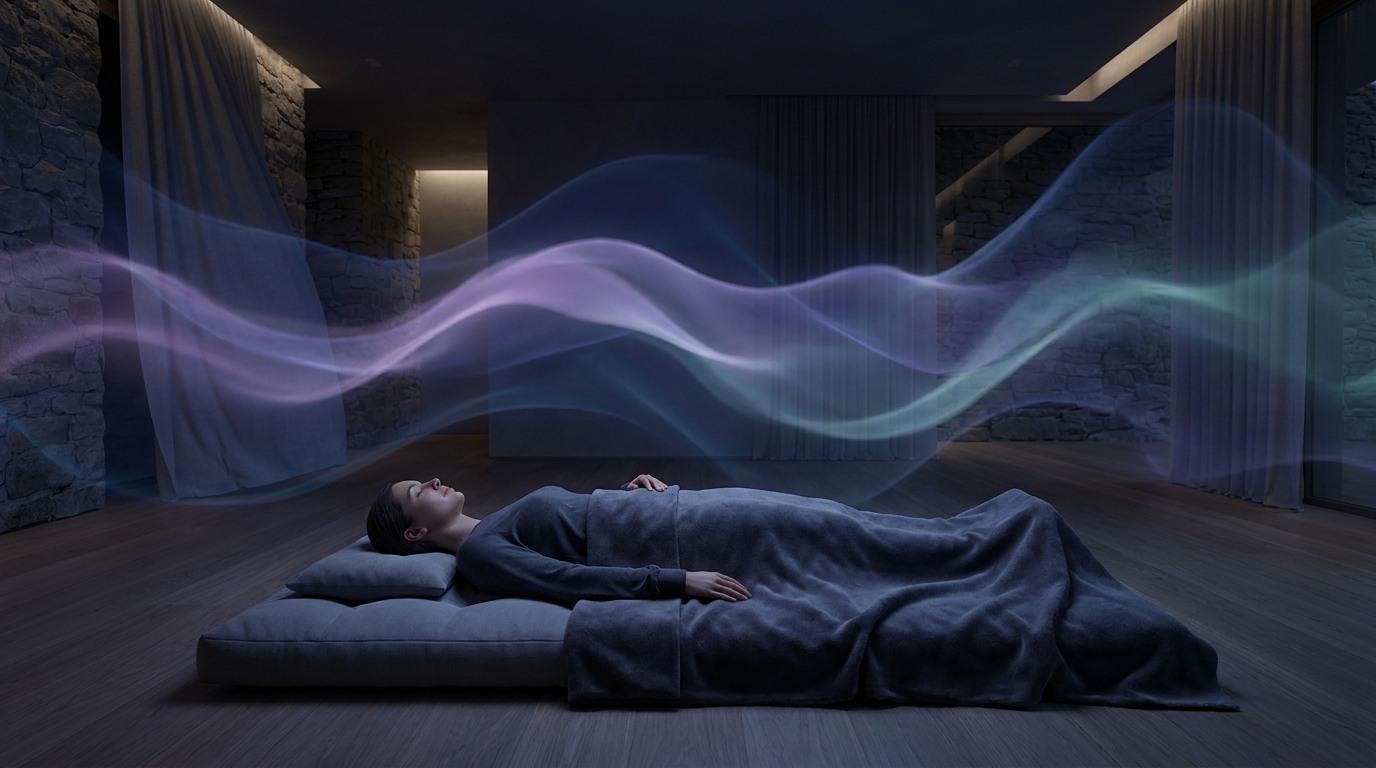
Yoga Nidra is called “yogic sleep,” which sets up the wrong expectation. It is not meant to put you to sleep. The whole practice is about staying right on the edge of it, awake but so deeply relaxed that the line between resting and sleeping nearly disappears.
That edge is the point. Holding you there, instead of letting you drop straight into sleep or stay tense and alert, is what seems to restore you. It teaches a nervous system that has forgotten how to let go what the doorway into rest actually feels like, without you white-knuckling your way through it.
So the honest question is not whether Yoga Nidra is magic. It is what the practice actually does, what the evidence really shows, and where it is still just promising. This page is the balanced overview.
What Yoga Nidra actually is
Yoga Nidra is a guided practice done lying down, in which someone leads you through a fixed sequence while you stay aware in the state between waking and sleep. The structure is consistent across traditions: you usually set a short resolve or intention (a sankalpa), then move through a rotation of awareness around the body, breath awareness, and some guided visualization. You are not doing poses and you are not trying to think about nothing. You are following a voice and letting your attention rest.
The systematized modern form most apps and studies use is associated with Swami Satyananda Saraswati and the Bihar School of Yoga, often called the Satyananda method. That lineage matters for one practical reason: protocols vary. Different teachers and different studies use somewhat different sequences and lengths, which makes the practice flexible but also makes the research harder to compare cleanly.
The simplest way to hold it in your head: Yoga Nidra is a structured rest practice, not seated meditation and not a nap. It is built around the boundary between awake and asleep, and it keeps you there on purpose.
Does Yoga Nidra help you sleep?
The early evidence says probably yes, with honest caveats. A 2025 systematic review of six randomized controlled trials (244 people total) concluded that Yoga Nidra “appears to show promise as a therapeutic intervention for improving sleep and related mental health outcomes.” Improvements showed up across fairly different groups: people with chronic insomnia, people with hypertension, healthcare workers during COVID-19, and athletes. In some of those trials, Yoga Nidra even compared favorably against established approaches like CBT-I, progressive muscle relaxation, and music-based relaxation.
That sounds strong until you read the fine print, and the reviewers are the ones who wrote it. Six trials is not many, the samples are small, and most of the studies carried a moderate-to-high risk of bias, mainly from a lack of blinding and incomplete reporting of outcomes. The favorable comparisons against CBT-I come from small, unblinded trials, so they are not enough to claim Yoga Nidra matches or beats the gold-standard insomnia treatment. The word the authors chose was “promise,” not “proven,” and they explicitly called for higher-quality studies.
So the fair read: if you struggle to fall asleep, Yoga Nidra is a reasonable, low-risk thing to try, and the signal that it helps is real. Just do not expect it to behave like a clinically established cure, because the research is not there yet.
Does it help with anxiety and stress?
This is where the evidence is a bit stronger. A 2026 systematic review and meta-analysis pooled 73 studies covering 5,201 participants and found that Yoga Nidra produced significant reductions in stress, anxiety, and depression compared with active control groups. The effect sizes were large, with anxiety in particular showing a big difference versus active comparators.
Large effects are encouraging, but they are also a reason to stay measured. Effects this big in heterogeneous, often-unblinded behavioral trials tend to shrink as study quality improves, so the true benefit is likely real but smaller than the headline numbers suggest. It is also worth being precise about what this review measured: stress, anxiety, and depression, not sleep itself. The two questions overlap (a calmer mind sleeps better), but they are not the same finding.
Put the two reviews together and a consistent picture emerges. Yoga Nidra reliably calms people down. Whether you frame that as better sleep, lower anxiety, or simply deeper rest, the practice is doing something measurable to the body’s stress response.
How Yoga Nidra works in the body
The leading explanation is that Yoga Nidra turns down the body’s arousal. The proposed mechanism is a downregulation of the autonomic nervous system: reductions in things like cortisol, blood pressure, and respiratory rate, which shift the body toward parasympathetic dominance, the “rest and digest” side. This lines up neatly with the hyperarousal model of insomnia, where the core problem is a nervous system stuck in a too-alert state at the wrong time. If your sleep problem is really an arousal problem, a practice that lowers arousal should help, and that is the theory here.
There is also a brain-state piece, though it is thin. An early and very small study (eight participants) observed an EEG signature consistent with deep relaxation during a meditative practice, including increased theta activity, the kind of brainwave pattern you would expect on the drowsy threshold Yoga Nidra aims for. It is a plausible fingerprint of the state, but with a sample that small it cannot carry much weight on its own.
Be honest about the status of all this. The mechanism is reasonable and partly measured, but the biomarker data are scattered across small studies rather than nailed down in large ones. The story holds together. It is not yet airtight.
The honest bottom line on the evidence
Here is the responsible synthesis across both major reviews. Yoga Nidra is low-risk, and it shows consistent positive signals for subjective sleep and for anxiety and stress. But the evidence base is dominated by small, methodologically limited trials, so it belongs in the category of promising complementary practice, not clinically established treatment. Anyone selling it as “clinically proven to cure insomnia” is overstating what the science actually says.
That honesty is not a reason to skip it. The downside of a guided lie-down rest practice is close to nothing, the time cost is low, and the upside, if you are one of the people it helps, is real. That is a very favorable trade for something this gentle. This is educational information, not medical advice, and if you have a persistent sleep or mental-health problem it is worth talking to a doctor or sleep specialist rather than relying on any single practice.
How to start
The easiest way in is to lie down, get comfortable, and follow a guided recording rather than trying to run the sequence from memory. Yoga Nidra was built to be led by a voice, and the structure (the intention, the body rotation, the breath, the visualization) is what does the work, so you do not have to manage any of it yourself. Pick a time that fits the goal: before bed if you want it to ease you into sleep, or earlier in the day if you want rest without necessarily falling asleep.
A few things to set expectations. Falling asleep partway through is normal and fine, especially early on. A session somewhere in the 20 to 30 minute range is a sensible starting point for bedtime, but a shorter practice you actually do every night beats a long one you skip. And give it more than one try. The benefit is in repetition, in slowly teaching your nervous system the way down.
If you want to feel what that edge of sleep actually feels like, the simplest first night is to press play on a short guided session, let the voice carry the structure, and see where it takes you.