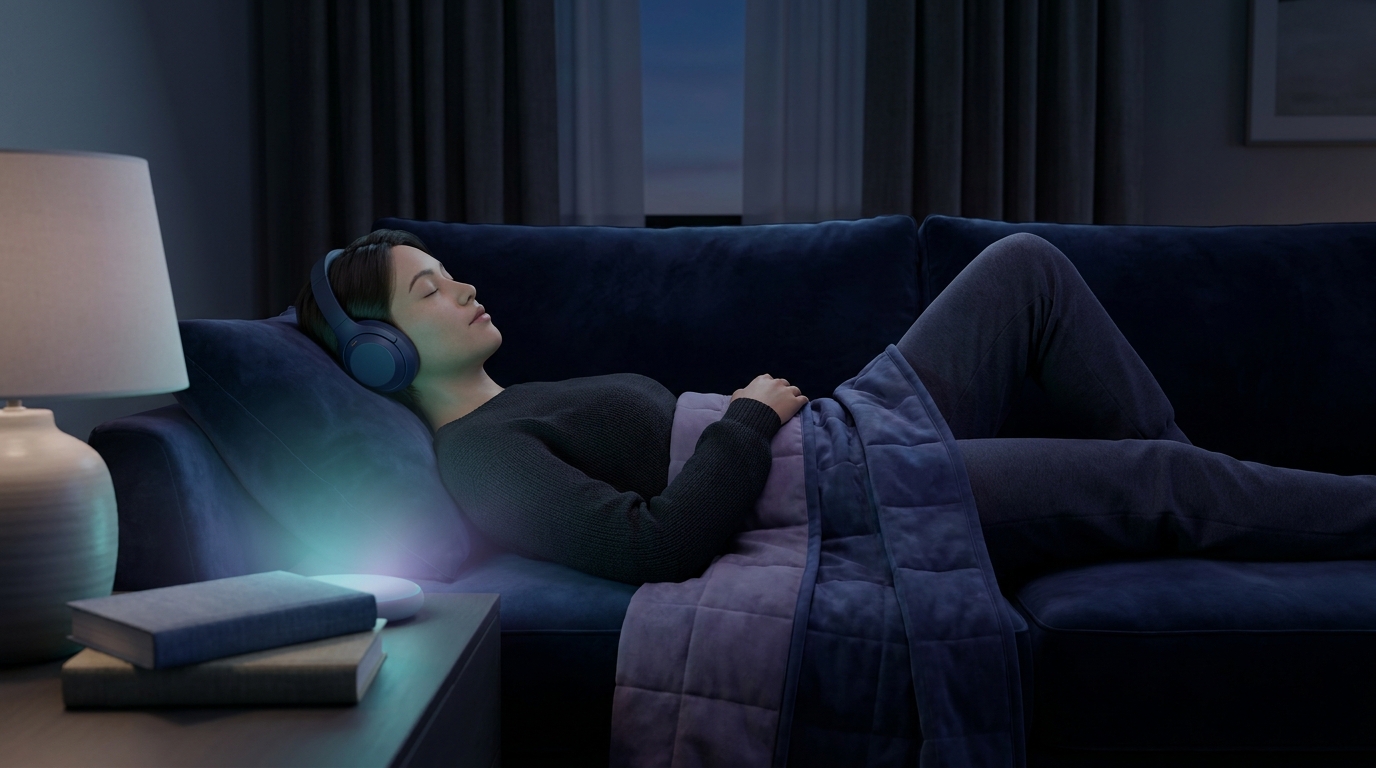
People come to NSDR expecting a technique, some specific sequence of breaths or a visualization they have to perform correctly. Then they read Huberman’s actual instructions and feel almost let down by how little there is to do. Lie down. Close your eyes. Breathe out slowly. Follow the voice.
That underwhelming simplicity is the whole point. There is no secret Huberman technique hiding in there. The “protocol” is mostly pressing play on a guided track and letting long, slow exhales do the work. The only real skill is not doing more, it is resisting the urge to steer. The version that works is the one where you stop trying to relax and just let the recording carry you.
What the protocol actually is
Huberman describes NSDR as a practice done lying down, eyes closed, with minimal movement, following guided audio that pairs long-exhale-emphasized breathing with a sequential scan of bodily sensations. The aim is to keep you in the state between wake and sleep, that drowsy edge where the body settles but you do not quite drop off.
If that sounds familiar, it should. This is essentially classical Yoga Nidra, the centuries-old guided relaxation practice, with one addition: an emphasis on extended exhales, which lengthen the parasympathetic “rest” phase of each breath. NSDR is just the modern, secular name Huberman gave it so people could use the protocol without the spiritual framing.
How to do it
Here is the full protocol, step by step. None of these steps require skill, only that you set up the conditions and then let go.
- Lie down somewhere comfortable where you will not be disturbed. Flat on your back is the classic position. Dim the lights and silence your phone after you start the track.
- Close your eyes and let your body get heavy. You do not need to arrange yourself perfectly. Small shifts are fine in the first minute, then settle into stillness.
- Start a guided NSDR or Yoga Nidra recording. For most purposes, 10 to 20 minutes is a good default. The voice will set the pace, which is exactly what you want, because it removes the temptation to manage the session yourself.
- Slow your breathing, with a longer exhale than inhale. This is the one active lever. You are not forcing a count, just letting each out-breath stretch a little longer than the in-breath. The long exhale is what nudges your nervous system toward “rest.”
- Follow the body scan. The voice will guide your attention from one body part to the next. Simply notice each area without trying to change anything. The scan gives your mind a quiet, almost boring task, which is how it stops chasing thoughts.
- When your mind wanders, return without judgment. Drifting is not failing. The moment you notice you have wandered, you are already back. If you slip toward sleep, that is fine too, though the practice works best when you stay just barely awake.
- Stay for 10 to 20 minutes, or longer if you are recovering from a bad night (more on that below).
- Come out slowly. When the recording ends, do not jump up. Take a few breaths, wiggle your fingers and toes, and let yourself transition gradually back to the room.
That is the entire thing. The hardest part is genuinely just allowing it to be this passive.
How long should it be?
Huberman says even a brief 10-minute session can be beneficial, so a short practice is not a watered-down version, it is a legitimate one. For recovering from poor sleep, he suggests going longer, around 30 to 60 minutes or more, and sessions can run anywhere from roughly 10 minutes to an hour.
One honest caveat: this duration guidance is practical and anecdotal, not pulled from dose-response trials. There is no study telling us that 22 minutes beats 18. So treat the numbers as sensible starting points, not precise doses. The length you will actually do, consistently, beats the “optimal” length you skip.
What Huberman claims vs what is actually evidenced
Part of doing the protocol well is having honest expectations, so it is worth separating the strong claims from the thin ones.
The dopamine claim, handle with care. Huberman often cites a finding that an NSDR or yoga-nidra-type session was associated with up to a 65% increase in dopamine. That number is real in the sense that a study reported it, but it traces to a single uncontrolled study of just eight people. It is reliable as “one small study found this,” and not reliable as “NSDR will reliably raise your dopamine by 65%.” If you go in expecting a guaranteed neurochemical surge, you are leaning on one of the weakest pieces of the case.
The relaxation mechanism, on solid ground. The protocol’s core lever, long exhales and slowed breathing while reclined, is a well-recognized route to parasympathetic (vagal) activation and reduced pre-sleep arousal. That breathing-to-rest link is genuinely well established. The part that gets over-claimed is the leap from “this calms your nervous system” to “this recovers you from sleep loss.”
The longer-term benefits, promising but adjacent. Huberman also points to research from Dr. Wendy Suzuki’s lab, where a daily 13-minute guided meditation increased attention and memory and reduced anxiety after eight weeks. That study is real, peer-reviewed, and controlled. Two honest footnotes: the intervention was meditation, not NSDR or Yoga Nidra specifically, and the benefits showed up at eight weeks of daily practice, not from a single session. So it supports the value of a consistent practice, not a one-time miracle.
The fair summary: the relaxation response is real and well grounded, the practice is low-risk and worth doing, and the flashier numbers deserve a raised eyebrow.
Does it replace sleep?
No, and Huberman is clear on this even if popular summaries strip the caveat out. He positions NSDR as a recovery tool to deploy after poor sleep, not a substitute for it. You stay awake the entire time, so the session never generates the slow-wave and REM architecture your brain needs to fully restore. NSDR can leave you calmer, sharpen your focus after an afternoon dip, and make it easier to fall asleep later. What it cannot do is the actual work that sleep does. Think of it as a complement, not a replacement.
This article is educational and is not medical advice. NSDR is a low-risk relaxation practice, but if poor sleep is a persistent problem, it is worth talking to a doctor or sleep specialist.
Doing it tonight
The fastest way to do the protocol right is to not run it yourself. When a guided voice sets the pace, you are freed from the one thing that tends to sabotage NSDR, the urge to control it. You just follow along, let each exhale run a little longer, and stay near the surface for 10 to 20 minutes. A short, guided Yoga Nidra session is the simplest place to start, and the whole point is that there is nothing to get right beyond showing up and pressing play.