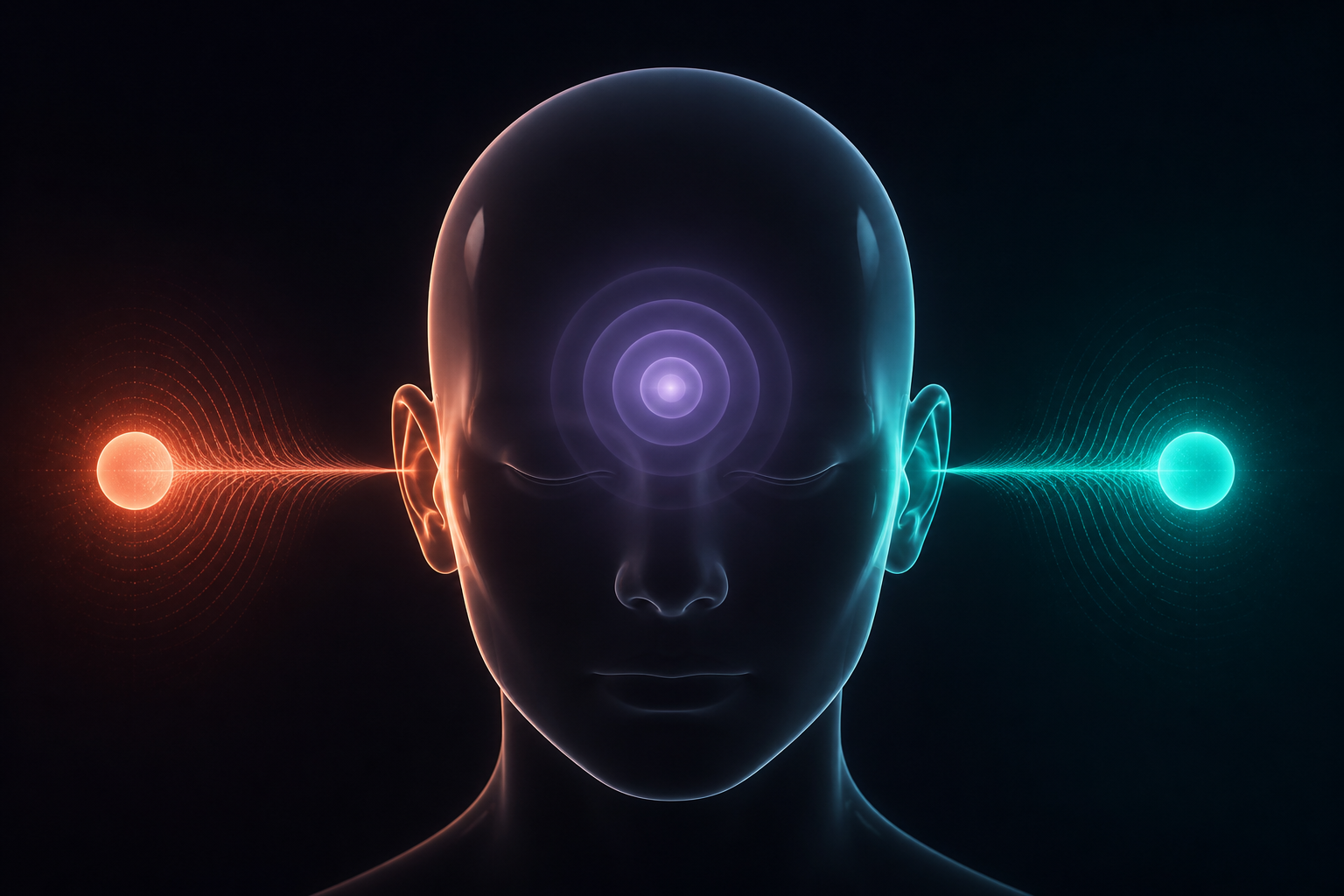
The basic mechanism
Play a steady tone in your left ear and a slightly different one in your right, and you’ll hear something neither ear is actually receiving: a soft, rhythmic pulse. That pulse is the binaural beat.
It isn’t in the audio at all. Your brainstem creates it while comparing the two ears. Play a 200 Hz tone on one side and 204 Hz on the other, and you perceive a gentle beat pulsing four times per second. The beat’s speed is always the difference between the two tones — that’s where the effect gets its name.
Why the Hz number isn’t the pitch
The Hz badge on a binaural beats track is its beat rate, not how high or low the sound is. A “4 Hz” track doesn’t sound low-pitched; it means the hidden pulse cycles four times each second.
Those numbers are chosen to loosely track the frequency bands seen in the brain’s own electrical activity: delta waves (roughly 1–4 Hz) dominate deep sleep, theta (4–8 Hz) drowsiness and meditation, alpha (8–13 Hz) relaxed calm, and beta (13–30 Hz) alert focus. A track built for sleep typically uses a slower beat rate; one built for focus, a faster one.
Why headphones are required
The effect depends entirely on each ear receiving its own tone so your brain can compare them. Through a speaker, the two tones mix in the air before they reach you, and the binaural beat never forms — you’d just hear pleasant, overlapping noise. If you’ve ever wondered why every binaural beats app insists on headphones, this is why.
Where the beat actually comes from
This isn’t a new or fringe discovery. Auditory beats were documented by physicist Heinrich Wilhelm Dove in 1839, and researchers have studied the auditory system generating them for well over a century. The phenomenon itself — two tones producing a perceived beat — is uncontroversial, well-understood acoustics.
What’s genuinely debated is what, if anything, listening to a beat does to your mood, sleep, or focus. That’s a separate, honest question worth asking directly — see does the beat itself help you sleep or focus? for the evidence as it actually stands.