The short version
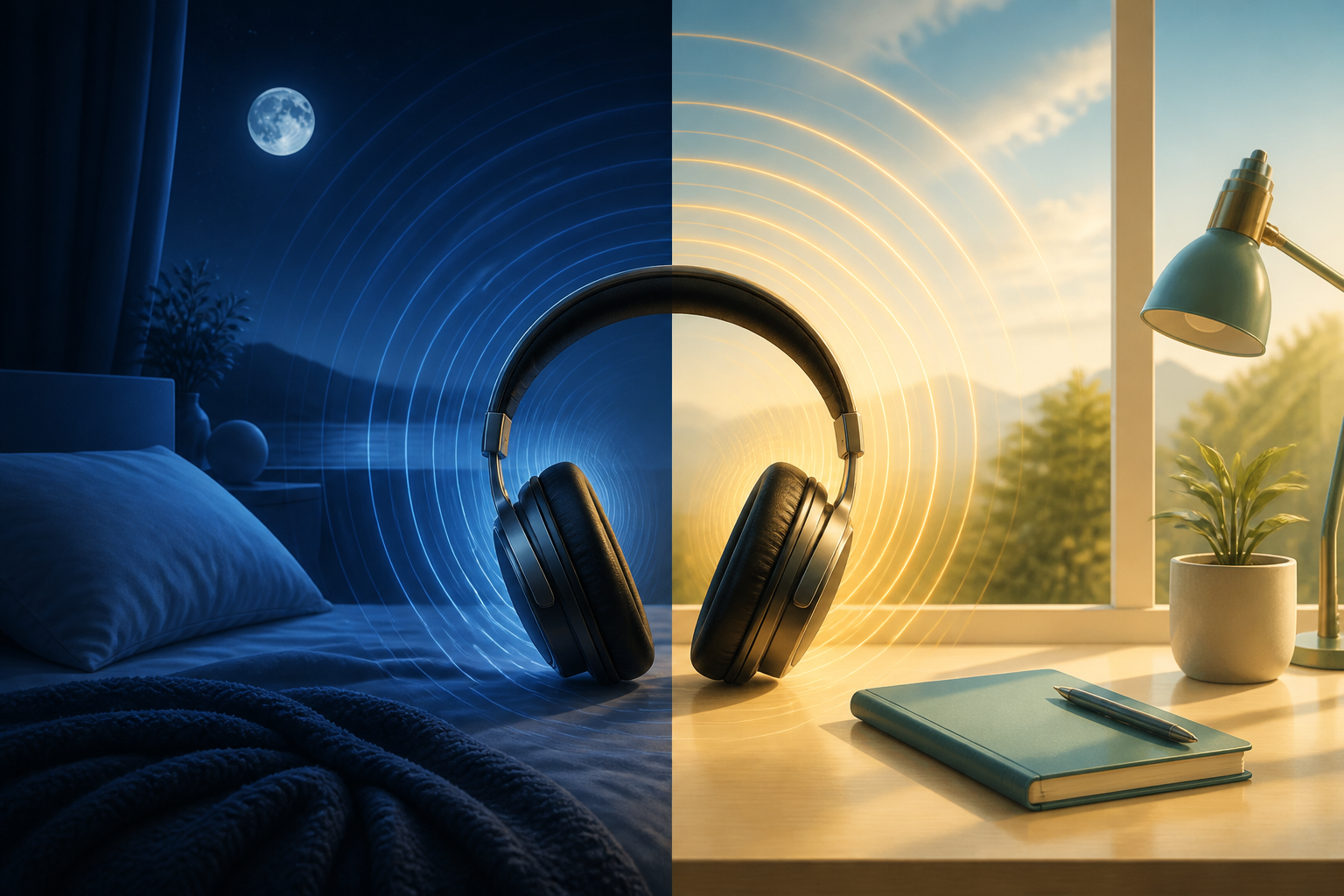
Sleep tracks run slow. Focus tracks run fast. Everything else is detail.
If you want a number to start with: somewhere in the 2–6 Hz range for winding down and sleep, somewhere in the 8–15 Hz range for focused work. Those are starting points to test, not prescriptions — and the rest of this page explains where they come from and how much weight the numbers can honestly carry.
Where the four band names come from
The delta / theta / alpha / beta labels aren’t marketing invention. They’re the standard vocabulary clinicians use to describe electrical activity recorded from the scalp on an EEG, and the ranges are well established:
- Delta — roughly 0.5–4 Hz. The slow, high-amplitude waves that dominate deep, restorative sleep.
- Theta — roughly 4–7 Hz. Drowsiness, the drift into light sleep, and states people describe as meditative.
- Alpha — roughly 8–12 Hz. Relaxed wakefulness. Classically what appears when you close your eyes but stay awake and calm.
- Beta — roughly 13–30 Hz. Alert, engaged, actively-thinking wakefulness.
Different references draw the boundaries a hair differently (you’ll see theta given as 4–8 Hz elsewhere), which tells you something useful straight away: these are descriptive bands, not precise switches.
How those bands became track titles
Binaural beats apps borrow the vocabulary directly. A “delta sleep” track sets its beat rate down in the delta band; an “alpha focus” track sets it in alpha. The reasoning is the entrainment hypothesis — the idea that a steady external rhythm nudges the brain’s own oscillations toward it, the way you fall into step with a walking companion without deciding to.
So the Hz choice is essentially: pick the brain state you want, then play a beat at the rate that state is named after. It’s an intuitive mapping. It’s also a bigger inferential leap than most track descriptions admit.
How much the number can honestly carry
Here’s the part the Hz charts usually skip. A 2023 systematic review in PLOS ONE looked specifically at whether binaural beats measurably shift brain oscillatory activity — the exact claim the Hz labelling rests on — and found the picture genuinely unsettled: some studies supported the entrainment hypothesis, more contradicted it, and the methods varied so much between studies that they were hard to compare at all. The authors’ own summary was that the question can’t be settled yet.
That doesn’t mean nothing happens. Individual studies have found real effects — one 2017 Frontiers in Neuroscience study reported that a 6 Hz beat increased theta activity across much of the cortex within ten minutes of listening. It means the field hasn’t converged, and anyone quoting an exact Hz as if it were a dial with a known output is going further than the research supports.
The practical reading: the Hz number is a reasonable, theory-guided starting point. It is not a specification with a dependable output, and it is not worth agonising over the difference between 4 Hz and 5 Hz.
Picking a rate, practically
For sleep and wind-down. Start in the 2–6 Hz range. There’s a case for starting nearer theta rather than deep delta: theta is the band associated with the drowsy transition you’re actually trying to enter, whereas delta belongs to a stage of sleep you’ll reach on your own once you’re under. Judge a track by whether it feels easy to stop paying attention to.
For focus and deep work. Start in alpha (8–12 Hz) if your work is reading, writing, or thinking, where a calm-but-awake state suits the task. Try beta (13–30 Hz) if you’re working through something more mechanical and want to feel switched on. Many people find beta too busy to work under — that’s a legitimate result, not a failure to use it right.
Give each one a fair trial. A single session tells you very little. Use one rate for several sessions of similar work before deciding, and change one thing at a time.
The part that works regardless
Whatever the beat is or isn’t doing to your oscillations, a Hz-labelled track is still a steady, engineered soundscape that masks disruption, gives a busy mind one consistent thing to rest on, and — used at the same point in your routine — becomes a cue your body learns. That benefit doesn’t depend on the entrainment hypothesis holding up.
Which is a good frame for the whole Hz question: choose a rate that matches what you’re trying to do, then judge it by how the session actually goes. For the broader evidence picture, see do binaural beats actually work for sleep and focus?, and for what the two tones are doing in the first place, what are binaural beats?.