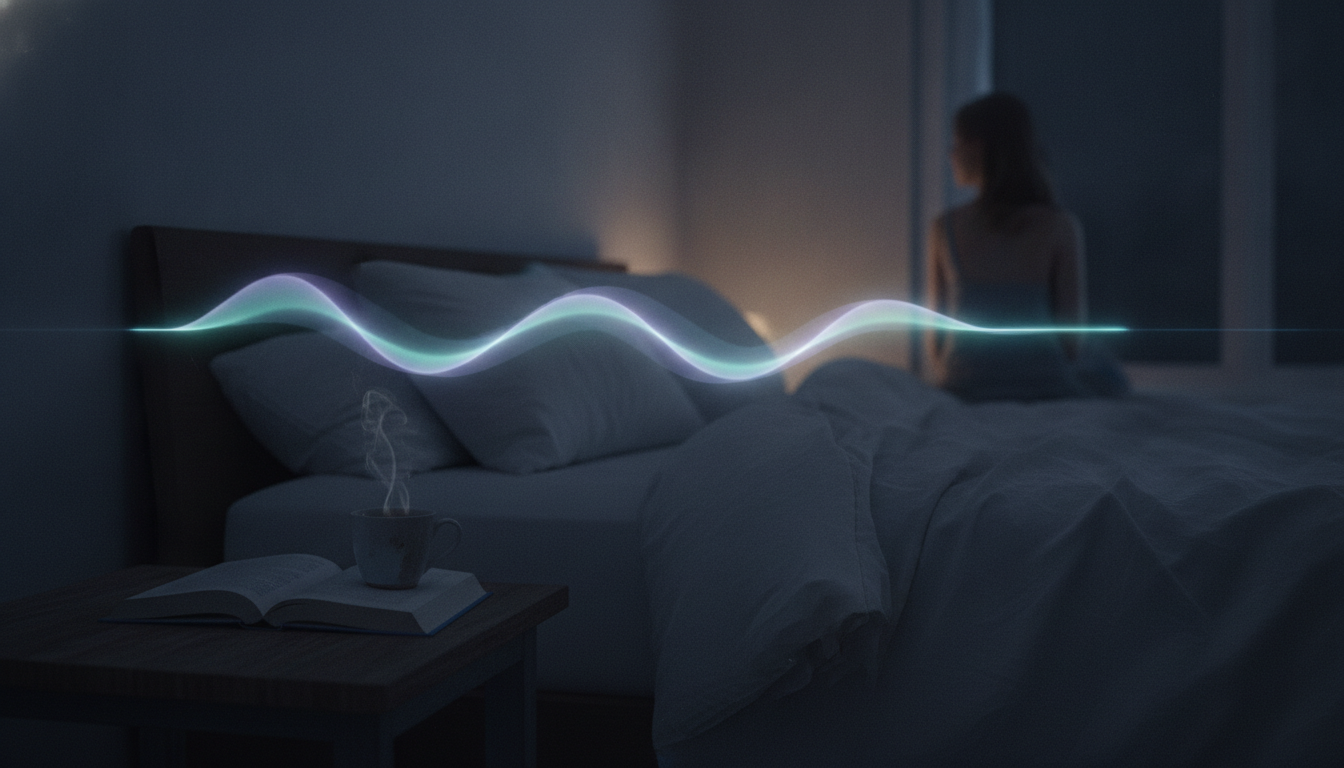
You’ve probably been handed the checklist before. No screens, dim the lights, take a bath, drink the tea, do the breathing. It reads like a chore list, and on a tired night it can feel like one more thing you’re failing at.
Here’s the reframe that actually makes a wind-down work. The point of a routine isn’t the individual items. It’s what they do together: they lower your arousal and they tell your brain that night has arrived and sleep is coming. You are not assembling the perfect bedtime ritual. You are sending one steady signal, over and over, until your body learns to read it.
That distinction changes how you use any of this. You don’t need every step. You need a small, repeatable sequence that calms your nervous system and cues your clock. Miss a piece on a given night and nothing breaks. What matters is that the sequence is consistent and that it points your physiology in one direction: down.
What a wind-down routine is actually doing
Two things, mostly.
The first is lowering arousal. The reason a lot of people lie in bed wide awake isn’t a lack of tiredness, it’s a nervous system that’s still switched on from the day. A wind-down is the off-ramp. Slow breathing, a warm bath, putting the day’s inputs away: these take your foot off the alertness pedal so your body can settle toward rest.
The second is signaling. Your internal clock takes cues from your environment, especially light and routine, to decide when to release melatonin and feel sleepy. When you dim the lights and do the same calming things at roughly the same time each night, you’re feeding that clock a clear, repeated message. The Sleep Foundation describes a bedtime routine as a set of activities done in the same order, every night, in the window before bed, precisely because the repetition is the active ingredient.
So a good routine isn’t a rigid checklist you grade yourself against. It’s a consistent signal you send. That’s the whole mindset shift.
A wind-down routine to try tonight
Here’s a concrete sequence. Adjust it to your life. The order and the timing matter more than hitting every single step.
Set a steady bedtime and wake time first
This is the foundation, and it’s the most evidence-backed habit on the list. The CDC’s first tip for better sleep is going to bed and getting up at about the same time every day, including weekends. Your wind-down has something to anchor to only if your sleep window is roughly fixed. If you change one thing, make it a consistent wake time, because that’s what stabilizes the whole clock.
Start winding down 30 to 90 minutes before bed
Pick a window and protect it. The Sleep Foundation suggests starting anywhere from 30 minutes to 2 hours before bed. You don’t need two hours. Thirty to forty-five focused minutes is plenty for most people. The key is that this is when the day stops, not when you cram in the last email.
Dim the lights and get off screens
This is the signaling step, and it’s where the science is strongest. Bright, blue-rich light in the evening suppresses melatonin and can push your internal clock later. In a Harvard study, people who read on a light-emitting device before bed took longer to fall asleep and had their circadian rhythm delayed by more than an hour compared to reading a print book. Aim for a device-free buffer of 30 to 60 minutes. If that’s unrealistic, dim everything you can, switch on a warm or red light filter, and avoid stimulating content like work, news, and doomscrolling.
Cool the room, and consider a warm bath
Your core temperature naturally falls as you drift off, and a cool room helps it along. Cleveland Clinic points to roughly 65 to 68 degrees Fahrenheit for most adults. Here’s the counter-intuitive part: a warm bath or shower an hour or two before bed can also help, because it pulls blood and heat to your skin, and your core temperature drops afterward. A meta-analysis in Sleep Medicine Reviews found that passive body heating one to two hours before bed shortened the time it took people to fall asleep. So warm bath, cool room, in that order.
Avoid the obvious arousal triggers
Caffeine has a long tail, so the CDC recommends avoiding it in the afternoon and evening. Alcohol is the sneaky one: it can make you drowsy at first but fragments sleep later in the night, so it’s worth keeping away from bedtime. Skip large, heavy meals close to bed too. None of these is a moral failing if you slip. They’re just inputs that fight the off-ramp you’re trying to build.
Spend the last ten minutes lowering arousal directly
This is where you actively downshift. Slow breathing with a longer exhale than inhale, progressive muscle relaxation, a body scan, or mindfulness meditation are all commonly recommended, and they share one job: calming the system. The Sleep Foundation lists deep breathing, progressive muscle relaxation, and mindfulness among its recommended wind-down activities. Don’t overthink which one is best. The best technique is the one you’ll repeat tomorrow night and the night after.
Being honest about the evidence
Not all of this is equally proven, and it’s worth saying so.
The strongest pieces are consistent sleep timing, reducing evening light, and the warm-bath effect, which has real mechanistic backing and, in the bath’s case, a meta-analysis behind it. The relaxation techniques are widely recommended and low-risk, but “which one is best” isn’t settled, and effects vary a lot between people. The herbal teas and specific snacks you’ll see in many routines are mostly gentle, pleasant habits rather than strongly evidenced sleep aids. Treat them as nice-to-haves, not load-bearing.
And one honest caveat about the whole category: a wind-down routine is a tool for ordinary restless nights, not a treatment. If you’re regularly unable to sleep for weeks or months despite good habits, that pattern can point to something like chronic insomnia, and the right next step is a doctor or sleep specialist. This article is educational and isn’t medical advice.
Make it small enough to actually keep
The most common way a wind-down fails is being too ambitious. Eight steps, perfectly executed, collapses the first busy week. Three steps you can do half-asleep survives.
If you remember nothing else: steady wake time, dim and screen-free for the last stretch, and ten minutes of something calming. That’s a complete routine. Everything above is optional refinement on top of those three.
That final ten minutes is the part people skip and the part that does the most direct work, because it’s where you actively take arousal down rather than just removing things that raise it. A short guided session, slow breathing or a calm body scan led by a voice so your mind has one quiet thing to follow, is one of the simplest ways to make those minutes land, especially on the nights when your own thoughts won’t quiet down on their own.