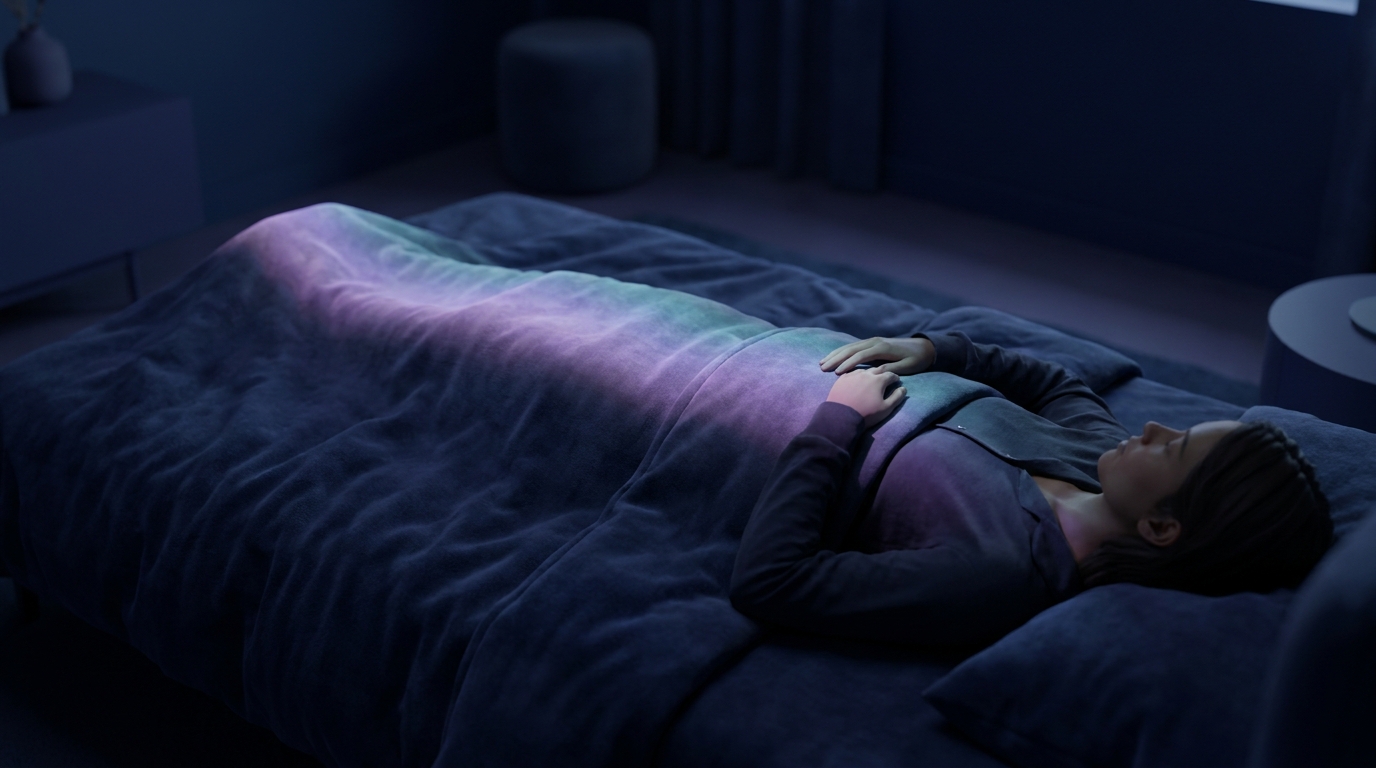
Most people try a body scan meditation expecting it to feel like a massage from the inside, a slow wave of relaxation rolling down the body until the muscles let go. Then they lie there noticing their tense shoulders, getting frustrated that nothing is loosening, and conclude it does not work for them.
That is the wrong scorecard. A body scan does not relax your muscles. It hijacks your attention. Moving your focus slowly through the body, one part at a time, hands a restless mind a single, dull, physical task to follow, and a mind busy following your left calf cannot also be drafting tomorrow’s to-do list. The relaxation, when it comes, is a side effect. The real work is giving your attention somewhere quiet to rest so it stops chasing thoughts.
That distinction changes how you practice it. You stop grading yourself on how relaxed you feel and start simply following along, which is the one thing the practice actually asks of you.
What a body scan meditation actually is
A body scan is a core component of Mindfulness-Based Stress Reduction (MBSR), which is one of the most extensively studied behavioral health interventions there is. The practice is simple to describe: you move your attention sequentially through regions of the body, noticing whatever sensation is there (warmth, pressure, tingling, or nothing at all) without trying to fix or change it.
It is worth being precise here, because the phrase “body scan” gets used for medical imaging too. This is the meditation practice, not a CT or PET scan. There is no machine and nothing is being measured. The only instrument is your own attention, and the only output is where that attention rests.
Why a body scan helps you fall asleep
A body scan helps you fall asleep because it lowers pre-sleep arousal, the mental and physical alertness that keeps you awake after you lie down. The proposed mechanism is that directing attention to neutral bodily sensation interrupts the cycles of worry and rumination that delay sleep, while engaging a relaxation, or parasympathetic, response.
In plain terms, your racing mind needs fuel, and that fuel is your attention. When you hand attention a slow, ordered, harmless job (notice the feet, now the shins, now the knees), the worry loop runs out of fuel and the body’s calming system gets room to take over. This is a well-reasoned model rather than a single proven cause. Arousal does measurably drop, but the exact “attention away from rumination” pathway is the best current explanation, not a settled fact.
How to do a body scan for sleep
You can run this from memory once you know it, but it is genuinely hard to lead yourself in the dark while also letting go, which is why a guided voice helps. Here is the practice, step by step.
-
Get set up to sleep, not to study. Lie on your back in bed, lights off, arms resting at your sides. Unlike a daytime mindfulness class where the goal is to stay awake and alert, here you are allowed, even encouraged, to drift off partway through.
-
Take a few slow breaths to start. Breathe normally, but let the first few out-breaths be a little longer than the in-breaths. You are not forcing relaxation, just signaling to the body that the day is done.
-
Bring your attention to your feet. Notice whatever is actually there: the weight of your heels, the temperature, a faint tingle, or nothing. You are observing, not improving. If a foot feels tense, you do not need to relax it. You just need to notice it.
-
Move slowly upward, one region at a time. Feet, then lower legs, knees, thighs, hips, belly, chest, hands, arms, shoulders, neck, face, scalp. Spend a few unhurried breaths on each. The slowness is the point. A rushed scan gives the mind too little to do.
-
When your mind wanders, walk it back without judgment. It will wander, often within seconds. That is not failure. The whole skill is the gentle return: notice you have drifted into thought, and bring attention back to wherever you left off in the body. Every return is a rep.
-
Let the finish be soft. If you reach the top of your head and you are still awake, either rest in a sense of the whole body at once, or simply start again at the feet. There is no score and no end you have to reach.
If you fall asleep at your thighs, the practice did its job. Falling asleep mid-scan is a success at bedtime, not a problem.
What the evidence really says
Here is the honest version, because being straight about the research is more useful than overselling it.
Mindfulness practices that include the body scan have real, measured benefits for sleep. In a randomized controlled trial of 54 adults with chronic insomnia, mindfulness-based programs produced clinically meaningful improvement, with total wake time dropping by roughly 44 minutes from baseline. In a separate randomized trial of older adults with moderate sleep disturbance, a six-week mindfulness program improved sleep quality significantly more than standard sleep-hygiene education. And a 2022 systematic review that pooled 14 randomized trials looking at body-scan meditation specifically found favorable effects on stress and wellbeing.
Now the limits. Most of this evidence tests full mindfulness programs, where the body scan is one ingredient among several, so “body scan evidence” is often really MBSR evidence. The trials tend to be small. And in that chronic-insomnia study, the sleep-specific protocol actually outperformed generic mindfulness, with the insomnia-targeted version reaching the highest remission at follow-up. The takeaway: a body scan is a legitimate, low-risk tool that lowers arousal and improves how people feel about their sleep, but it is best understood as an effective adjunct, not a cure.
That is why the American Academy of Sleep Medicine still names CBT-I (cognitive behavioral therapy for insomnia) as the strongly recommended first-line treatment for chronic insomnia. Mindfulness approaches show benefit on a smaller, less-established evidence base. So if you have the occasional restless night, a body scan is an excellent thing to reach for. If you cannot sleep most nights for months, treat the body scan as something that sits alongside proper care, and talk to a doctor or sleep specialist. This article is educational and is not medical advice.
Trying it tonight
The hardest part of a body scan in bed is that you are trying to lead yourself and let go at the same time, and the two pull against each other. It is far easier to simply follow. Let a calm guided voice walk your attention down the body, region by region, while you do nothing but listen, and let yourself drift off whenever it happens.