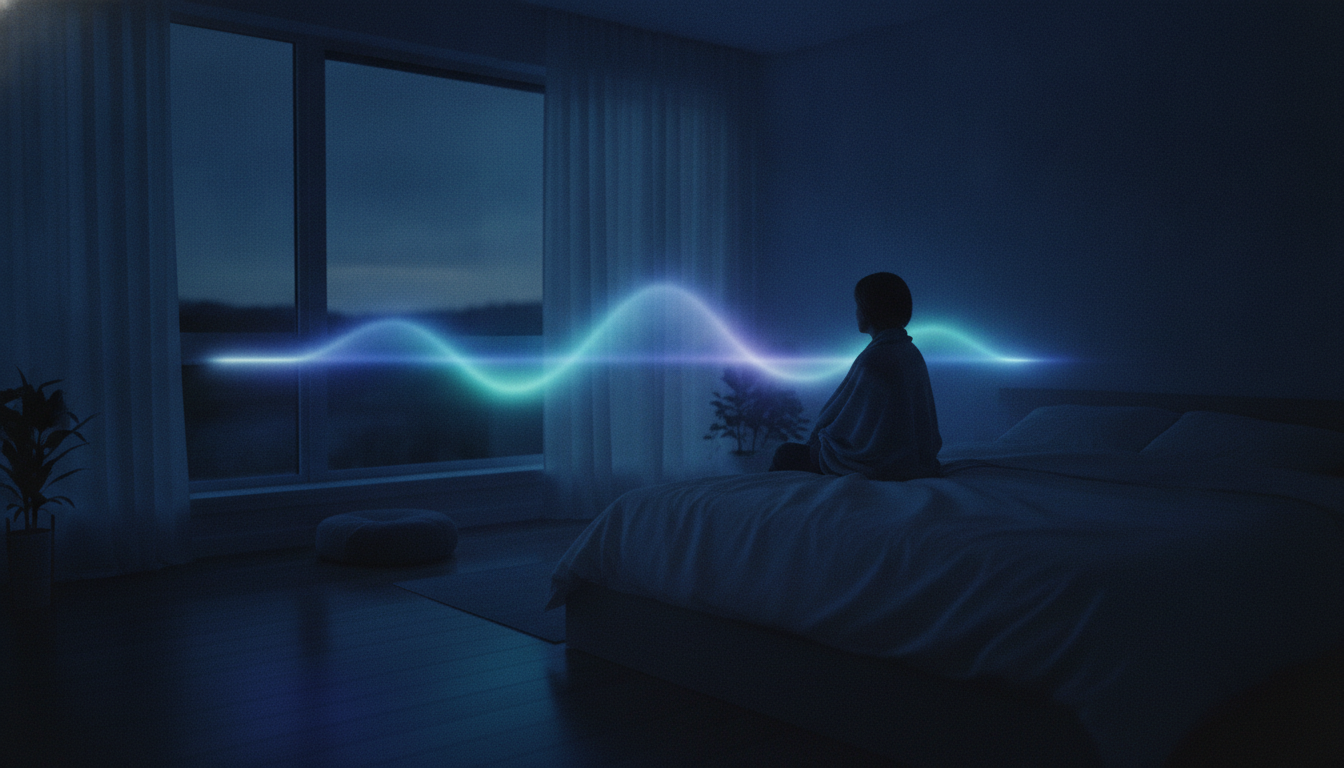
What is deep sleep meditation, really?
Deep sleep meditation is a guided practice you do at bedtime to relax your body and quiet your mind so sleep arrives more easily. Notice what that sentence does not say: it does not promise to manufacture extra deep sleep. That distinction is the whole story, and most marketing gets it backwards.
The phrase “deep sleep meditation” usually points at one of two things. Either a recorded voice walks you through slow breathing and a body scan until you drift off, or a soothing audio track is sold with the suggestion that it will somehow build more slow-wave sleep overnight. The first is genuinely useful. The second is mostly hope dressed up as science.
Here is the honest frame: meditation is very good at helping you enter sleep calmly, and that is worth a lot. What it does not reliably do is reach into the back half of the night and add more of the deep, slow-wave sleep your brain runs on its own schedule.
Does meditation actually create more deep sleep?
Probably not directly, and the cleanest evidence comes from a study that measured it. In the Mindfulness Sleep Therapy (MIST) trial, older adults with sleep complaints did either a mindfulness program or sleep-hygiene education, and researchers recorded their sleep with overnight polysomnography (the gold-standard EEG setup that stages sleep).
The result was telling. Both groups felt their sleep improved. But the mindfulness group did not show an increase in N3, the slow-wave deep-sleep stage. If anything, it was the sleep-hygiene group that nudged N3 upward, while slow-wave activity itself did not differ between groups. The mindfulness benefit showed up elsewhere in the night, not as a pile of extra deep sleep.
So when a product promises that pressing play will give you “more deep sleep,” treat it as a red flag. The brain regulates slow-wave sleep based on how long you have been awake and your overall sleep health, not on a soundtrack.
How deep sleep meditation actually helps
It lowers pre-sleep arousal, which is the real lever. Pre-sleep arousal is that wired, busy state where your thoughts won’t stop and your body won’t settle, and it is one of the biggest things standing between you and sleep onset.
This is where the evidence is genuinely supportive. In a randomized trial of adults with chronic insomnia, meditation-based approaches produced a large drop in pre-sleep arousal and cut total wake time by roughly 44 minutes, far more than the control group. A separate clinical trial in older adults found a six-week mindfulness program improved sleep quality more than standard sleep-hygiene education.
The mechanism is unglamorous and believable. Slow breathing and steady attention shift you toward “rest and digest” nervous-system activity, pull focus away from rumination, and let your body settle toward the drowsy threshold it normally crosses before sleep. You are not forcing sleep. You are removing the arousal that was blocking it.
One honest caveat: these trials are mostly small, and meditation is a support, not a first-line treatment. For chronic insomnia, cognitive behavioral therapy for insomnia (CBT-I) remains the strongly recommended option, with meditation working best as a companion to it.
A 10-minute wind-down you can do tonight
You do not need anything except a bed and a few quiet minutes. Run this as you are settling in for the night.
- Lie down and get genuinely comfortable. On your back is fine, or whatever position you usually fall asleep in. Dim the lights. You are not trying to stay awake.
- Take five slow breaths, longer on the exhale. Breathe in for about four counts, out for about six. The longer exhale is what tips you toward the calming branch of your nervous system.
- Scan your body from feet to head. Rest your attention on your feet, then ankles, calves, and slowly upward, letting each part go heavy. Spend a few unhurried breaths in each region.
- Let thoughts pass without chasing them. When you notice your mind has wandered into tomorrow’s to-do list, that is normal. Gently bring attention back to the breath or the body. The returning is the practice.
- Stop steering. Once you feel heavy and slow, drop the technique entirely and let yourself drift. If you fall asleep mid-scan, the practice did its job.
Do this most nights and the wind-down becomes a cue: lying down and slowing the breath starts to signal “sleep is coming,” which makes onset easier over time.
Doing it with a guided voice
The hardest part of the practice above is steering it yourself while trying to fall asleep, which is why a guided recording works so well. A voice handles the structure, the pacing, and the body scan, so you can stop thinking and simply follow along until you slip under. A library of guided Yoga Nidra and deep-relaxation sessions in different lengths lets you match the practice to the night, whether you need a short reset or a longer wind-down. That is the realistic promise of deep sleep meditation: not more slow-wave sleep on command, but a calmer, faster path into the sleep you were going to have anyway.