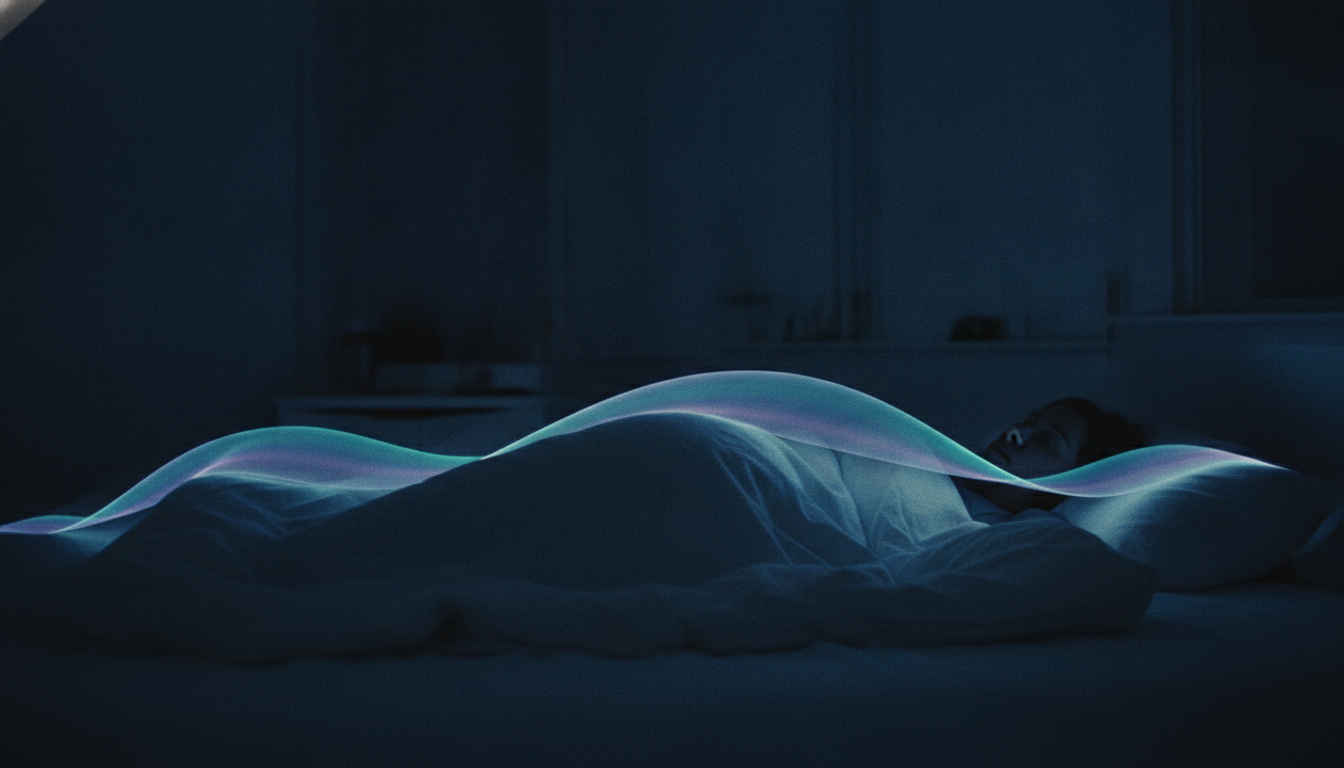
How does a body scan calm anxiety at night?
A body scan calms nighttime anxiety by giving your attention somewhere neutral to go. Instead of orbiting tomorrow’s to-do list, your mind has a simple job: notice your left foot, then your calf, then your knee. That sounds almost too plain to matter. But the plainness is the point.
Nighttime anxiety isn’t usually a thinking problem you can out-argue. Lying in the dark, the lights off and the distractions gone, an anxious brain finally has the floor, and it takes it. You try to reason your way calm, and the reasoning becomes more thinking, which is more fuel. A body scan steps sideways out of that loop instead of fighting it head-on.
The relevant idea from sleep science is pre-sleep arousal: the wound-up state that keeps you awake. Researchers measure it in two parts, and both run high in people who struggle to sleep. There’s the cognitive side (racing thoughts, worry, planning) and the somatic side (a tight chest, a fast heart, restless muscles). A body scan happens to work on both at once.
What is pre-sleep arousal, and why does it keep you awake?
Pre-sleep arousal is your nervous system staying switched “on” when it should be powering down. In a randomized controlled trial of adults with chronic insomnia, meditation-based programs reduced scores on the validated Pre-Sleep Arousal Scale by an average of 7.13 points, compared with just 0.16 in a self-monitoring control group. That is direct evidence that quieting practices lower the measured arousal that delays sleep.
Anxiety at bedtime is essentially that arousal running hot. The cognitive half shows up as a mind that won’t stop narrating; the somatic half shows up as a body that won’t stop bracing. Most “just relax” advice targets only one half. A body scan reaches both, which is part of why it suits anxious nights.
How does shifting attention to the body quiet the mind?
It quiets the mind by occupying the same attentional space the worry was using. Your attention is largely single-channel: when it’s genuinely resting on the sensation in your shins or your jaw, it isn’t simultaneously rehearsing a stressful conversation. The proposed mechanism in the research is exactly this, that directing attention to neutral bodily sensation interrupts cycles of worry and rumination and engages a relaxation response, lowering the arousal that keeps you up.
This is a model, not a fully proven single cause, and it’s worth being honest about that. But the downstream effect is well documented. The body scan is a core component of Mindfulness-Based Stress Reduction, one of the most heavily studied behavioral health programs, and a 2022 systematic review and meta-analysis pooling 14 randomized trials of body-scan meditation specifically found favorable effects on stress and wellbeing.
Does the body scan actually relax the body too?
Yes, and that’s the somatic half doing its work. As you move attention through each region, you tend to notice tension you were holding without realizing it, the clenched jaw, the hiked shoulders, and noticing it lets it soften. Slow, unhurried attention paired with longer exhales nudges you toward parasympathetic (“rest and digest”) activity, the same direction your body drifts right before sleep.
In a clinical trial of older adults with sleep disturbance, a mindfulness program that included body-scan practice improved sleep quality significantly more than standard sleep-hygiene education. The effect is real, though it’s best understood as genuine support for winding down rather than a fix for anxiety or insomnia.
A body scan you can do in bed tonight
You don’t need anything except your bed and a few quiet minutes. Try this:
- Lie on your back, arms a little away from your sides, legs uncrossed. Let the mattress fully take your weight.
- Take three slow breaths, making the exhale a touch longer than the inhale. No forcing, just a gentle lengthening on the way out.
- Start at your feet. Rest your attention on your left foot. Notice whatever’s there, warmth, pressure, tingling, or nothing in particular. There’s no right sensation to find.
- Move slowly upward, one region at a time: foot, lower leg, knee, thigh, then the same on the right. Then hips, belly, chest, lower back, hands, arms, shoulders.
- Soften as you go. When you reach a tense spot, like the shoulders or jaw, let the next exhale carry a little of the tension out.
- Finish at the head, face, scalp, the whole body at once. Rest there.
- When your mind wanders into worry (it will), that’s fine. Notice it, and gently return to the body part you’d left. The returning is the practice, not a sign you’re doing it wrong.
If you fall asleep partway through, no problem, that was rather the idea. If you stay awake to the end, you’ll usually find the edge of sleep is closer than when you started.
Letting a voice do the steering
The hardest part of an anxious-night body scan is that the anxious mind is also the one running the scan, so it’s quick to wander back to the worry. A guided recording removes that friction: a calm voice paces each region for you, so all you do is follow and let go. To do a guided body scan built for exactly this kind of nighttime wind-down, the Yoga Nidra app has narrated sessions you can start the moment your head hits the pillow.