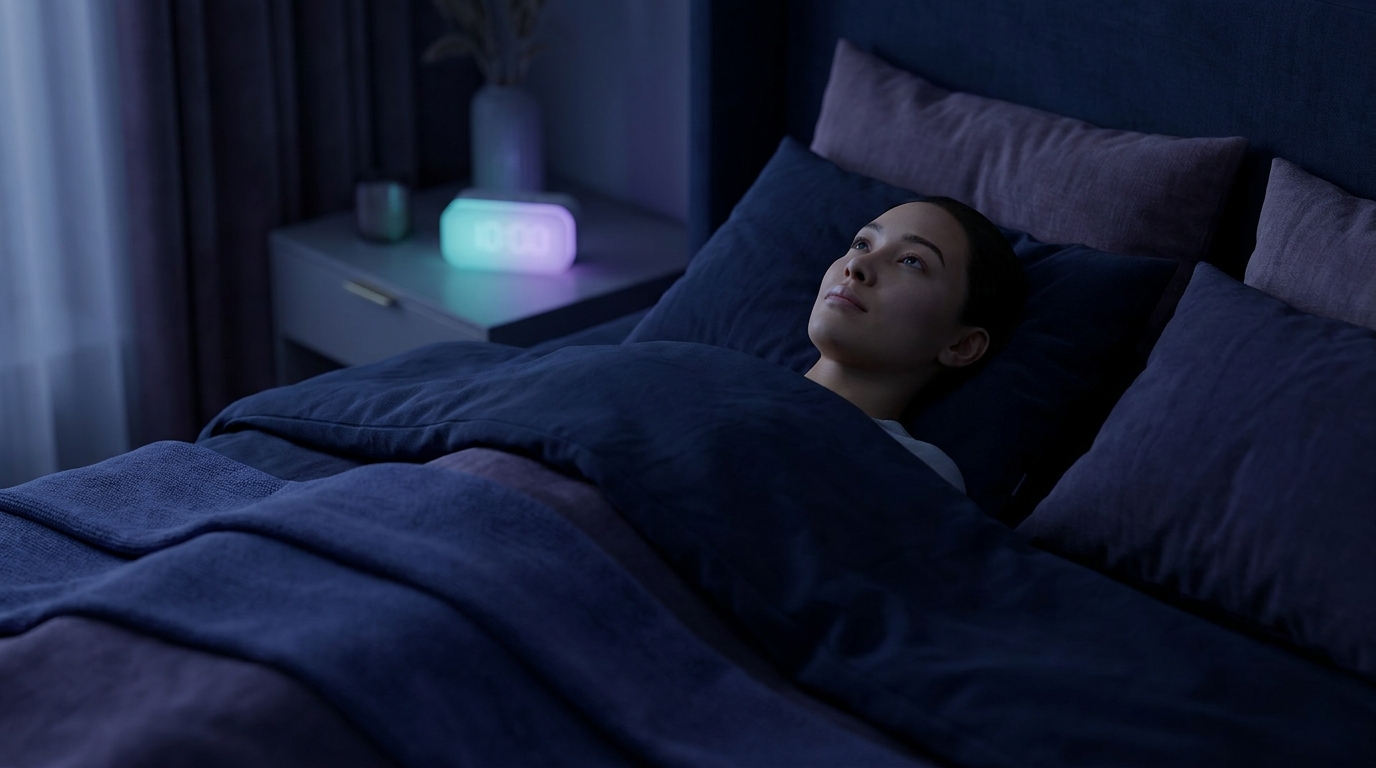
You were yawning on the couch an hour ago. Now your head is on the pillow, the lights are off, and you are somehow more awake than you have been all day. Your body is clearly wrecked, so why won’t it just shut down?
Here is the thing most advice gets wrong. Being tired and being able to sleep are not the same state, and they do not run on the same switch. You can be completely wiped out and still nowhere near the calm that lets sleep arrive. So feeling “tired but wired” is rarely a shortage of tiredness. It is a surplus of alertness.
And the cruel part is that trying harder makes it worse. Effort is itself an alerting signal. The more you lie there willing yourself to fall asleep, the more switched-on you keep the very system that is blocking you.
Why you can be tired and unable to sleep at the same time
Because two separate systems decide your sleep, and they can disagree. Sleep scientists describe this with the two-process model: one process, your homeostatic sleep pressure, builds up the longer you stay awake (that is the tiredness you feel), while a second, your circadian pacemaker, gates when that pressure is actually allowed to turn into sleep (Borbély et al., 2016).
Most nights they line up. You get tired, your circadian clock opens the gate, you drift off. But “tired but can’t sleep” is what happens when they clash: you have plenty of sleep pressure, yet your circadian and arousal state is still saying “stay up.” High tiredness, blocked exit. That is the whole frustrating experience in one sentence.
This is why the goal is not to manufacture more tiredness (you already have it). The goal is to remove whatever is keeping the gate shut.
Why you feel most awake right before bed
There is a normal circadian window, roughly the two to three hours before your usual bedtime, when your body actually ramps up alertness. Researchers call it the wake-maintenance zone, or more vividly, the “forbidden zone for sleep” (Lavie, 1986). During this window a strong circadian arousal signal pushes back against your accumulated tiredness, making this the hardest time of the whole day to fall asleep. Then, fairly abruptly, a “sleep gate” opens and sleep comes much more easily.
This matters because it reframes a common panic. Being exhausted but wide awake at 10pm is not a malfunction. It is biology doing exactly what it does, and it is especially pronounced for evening chronotypes (night owls) and adolescents. Knowing the window exists takes some of the pressure off: you are not broken, you are early.
The “wired” part is usually a stress system that won’t power down
The other reason you stay alert when you are tired is hyperarousal: a nervous system and stress-hormone axis that stay switched on when they should be winding down. Chronic insomnia is increasingly understood not as a simple lack of sleep drive but as a disorder of this persistent arousal, involving the sympathetic nervous system and the HPA (cortisol) axis (Endotext, NCBI Bookshelf).
Cortisol is the useful detail here. It is supposed to follow a daily arc, low in the late evening and around midnight, then climbing toward morning (Frontiers in Neuroscience, 2022). So your body is built to have very little cortisol circulating at bedtime. When a stressful day, late work, or a churning mind keeps that stress response elevated into the evening, it runs directly against the low-cortisol state that normally permits sleep.
A systematic review and meta-analysis of people with chronic insomnia found altered HPA-axis activity consistent with this hyperarousal picture (Dressle et al., 2022). Worth being honest about the evidence: this describes a directional, real pattern across studies, not a precise reading of your one bad night, and being wired for an evening does not mean you have insomnia. But it does explain why “tired but can’t sleep” so often shows up after stressful, overstimulating days.
How to actually fall asleep when you’re tired but wired
Since you cannot force sleep but you can lower alertness, the entire move is to switch off arousal and let the sleep gate open on its own. Here is what to do, both over the next few days and tonight.
Stop trying to fall asleep
Counter-intuitive, but central. The effort of forcing sleep is an alerting signal. If you have been lying awake doing sleep math (“if I fall asleep now I still get six hours”), that calculation is keeping you online. Let go of the outcome. Aim only to rest your body and calm your system, and let sleep be a side effect rather than the target.
Protect the wind-down window
Your circadian timing responds to light and routine, so the hours before bed do most of the work. Keep your sleep and wake times reasonably regular, because irregular schedules and late light exposure can push your circadian arousal signal and melatonin timing out of sync with your intended bedtime (Borbély et al., 2016). Dim the lights and get off bright screens well before you lie down, so you are not feeding the alerting signal exactly when you want it fading.
Spend ten to fifteen minutes lowering arousal
This is where you actively downshift the wired half. A slow, comfortable breathing pattern with a longer exhale than inhale nudges your nervous system toward rest. A body scan, moving your attention gently from your feet upward without trying to change anything, gives a busy mind one quiet task instead of a stress to chew on. The aim is not to “relax harder,” it is to take your foot off the alertness pedal so cortisol and sympathetic drive can settle toward where they belong at night.
If you are wide awake, do not lie there fighting
If the gate clearly has not opened and you have been awake a while, it is fine to get up, keep the lights low, and do something calm and boring until you feel sleepy, then return to bed. Lying in bed straining to sleep mostly reinforces the link between your bed and being wired. You are waiting for the sleep gate, not prying it open.
When tired-but-wired is worth taking seriously
An occasional tired-but-wired night is normal and usually just circadian timing or a stressful day catching up with you. The reframe and the wind-down above are the right tools for that.
But if you are regularly exhausted yet unable to fall or stay asleep, most nights, for months, that pattern fits chronic insomnia, which is tied to the ongoing hyperarousal described above. That is not something a single breathing trick resolves. If it persists, talk to a doctor or a sleep specialist. This article is educational and is not medical advice.
The practical takeaway is the same one your physiology has been hinting at all along: you cannot command sleep, but you can quiet the system that is blocking it. A short guided wind-down, breathing slowly or following a calm body scan, is simply the most reliable way to take alertness down a notch and let sleep arrive on its own.