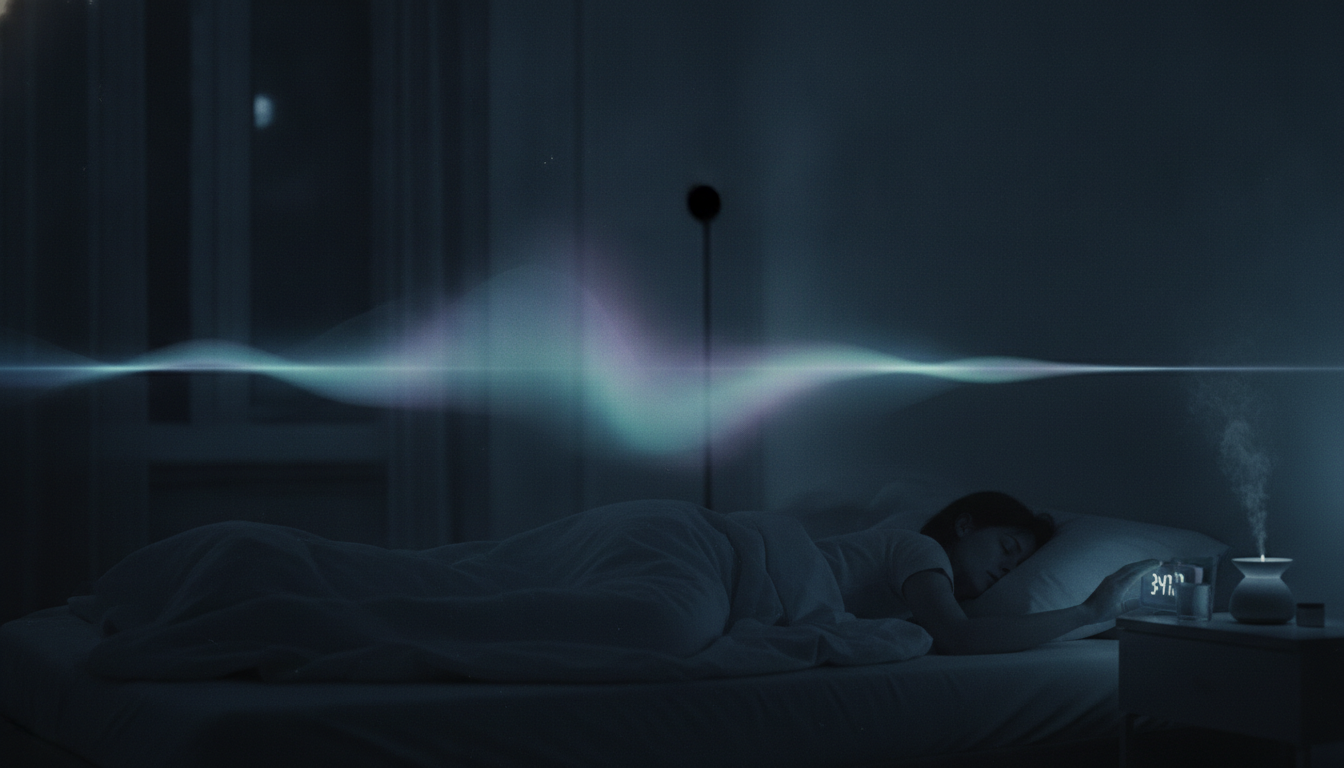
Here is the reassuring part nobody tells you first: waking up at 3am is, for most people, a completely normal feature of how a night of sleep is built. It feels ominous because the house is dark and silent and your brain has nothing to do but notice that you are awake. But the waking itself is rarely the problem. What keeps you up is what you do in the ten minutes after.
You probably surface briefly several times most nights and never remember it, because you fall straight back to sleep. The 3am wakings you remember are the ones where something, a full bladder, a noise, a thought, or just the lightness of the sleep you are in, held you on the surface long enough to notice. Understanding why that surface is so easy to reach around 3am takes most of the fear out of it.
Why 3am specifically, and not some random hour
Because by 3am you have already spent your deepest, hardest-to-wake sleep, and you are now in the light, dreaming part of the night. Sleep is not one flat state. You move through cycles of about 90 to 120 minutes, and the makeup of each cycle changes as the night goes on. The first half of the night is rich in deep, slow-wave sleep (during early cycles, those deep stages commonly last 20 to 40 minutes). As the night progresses, deep sleep shrinks and REM (the dreaming stage) stretches out, with later REM stages lasting up to an hour (Sleep Foundation, Stages of Sleep).
So if you fell asleep around 10 or 11pm, then by 3am you are several cycles in, parked in the lightest, most easily disturbed sleep of the night. As one Cleveland Clinic sleep specialist puts it, for adults on a standard schedule, 3am is “typically when you’re in REM sleep” (Cleveland Clinic). More time gets spent in light sleep as the night progresses, which is exactly when a noise, a thought, or a small bodily signal can lift you to full waking (Sleep Foundation). 3am is not mystical. It is just where the easy-to-wake part of your night happens to land.
Why your body picks the exact same time every night
If it is always 3am on the dot, that is usually conditioning, not coincidence. Your body is very good at learning patterns. At some point you may have had a real reason to wake around then: a crying baby, an early shift, untreated sleep apnea, a noisy neighbor. The reason goes away but the habit can stay, and your internal clock keeps firing at the time it learned, “like clockwork” (Cleveland Clinic). It is the same machinery that lets some people wake a minute before their alarm.
This is worth knowing because the cure for a conditioned waking is mostly patience and not over-reacting to it. The more you treat 3am as an emergency, the more your brain flags it as important, and the more reliably it wakes you.
The cortisol rise that nudges you toward morning
Around the second half of the night, your stress hormone cortisol is already climbing, and that climb gently tilts your body away from deep sleep and toward alertness. Cortisol follows a daily rhythm: low in the late evening, then rising across the early morning hours toward a peak shortly after you wake. Deep, slow-wave sleep actively suppresses cortisol, while lighter sleep and wakefulness go hand in hand with cortisol increases (Endotext, NCBI Bookshelf).
Put those two facts side by side and 3am makes sense. You are in light sleep precisely when cortisol is on its way up, so your system is primed to wake more easily than it was at midnight. This is normal physiology, not a malfunction. Trouble starts only if stress keeps your system reactive at night, because then a routine arousal is more likely to tip into full, frustrated wakefulness. Sleep researchers call this sensitivity sleep reactivity, and people higher in it lose more sleep during stressful stretches (Sleep Foundation). An occasional wired 3am after a hard day is ordinary; a relentless nightly version is worth taking more seriously, which we will get to.
Other ordinary reasons you wake at 3am
Several plain, physical causes pile onto that light-sleep window, and they are easy to miss.
- Alcohol. A drink helps you fall asleep, then sabotages the second half of the night. As your body clears it, sleep gets lighter and more fragmented with a rebound in REM and wakefulness, which is why a nightcap so often ends in a 3 or 4am waking you cannot shake (Sleep Foundation, Alcohol and Sleep).
- Your bladder. Waking with the urge to pee (nocturia) is a common trigger, more frequent with age and with fluids late in the evening (Sleep Foundation).
- Noise and light. In light sleep, the threshold for being woken by traffic, a phone, a partner, or early light is much lower than earlier in the night (Sleep Foundation).
- Age. Older adults get less deep sleep and spend more time in lighter stages, so waking three or four times a night becomes typical rather than alarming (Sleep Foundation).
None of these mean something is broken. They mean a normal light-sleep arousal got a small nudge.
What to do at 3am (and what to stop doing)
The single most useful move is to stop fighting it, because the fighting is what converts a brief waking into an hour of staring at the ceiling. Here is the approach sleep specialists actually recommend.
Do not look at the clock
Checking the time is the classic trap. The moment you see “3:14” your mind starts the math (“if I sleep now I get four hours”), and that calculation is itself an alerting, mildly stressful signal that works against sleep. Turn the clock away. You do not need to know the time, and not knowing it is genuinely calming.
Stay in the dark and stay boring
Do not reach for your phone. Light and engaging content tell your brain it is time to be awake, exactly the wrong message. If you are lying there comfortably and not distressed, stay put, keep your eyes closed, and let yourself drift. Brief awakenings are normal and most resolve on their own if you do not feed them.
If you are still wide awake, get up
If you have been awake long enough to feel frustrated (a rough sense of 15 to 20 minutes is fine, no clock-watching needed), it is better to get out of bed than to lie there straining. Cleveland Clinic’s advice is direct: when you are frustrated that you cannot fall back asleep, do not keep lying in bed awake (Cleveland Clinic). Go to another dimly lit room, do something calm and dull (gentle reading, slow breathing, a quiet meditation), and return to bed only when you feel sleepy. This keeps your bed associated with sleep rather than with lying awake and annoyed.
Lower the arousal instead of chasing sleep
You cannot force yourself back to sleep, but you can take your foot off the alertness pedal. A slow breathing pattern with a longer exhale than inhale, or a gentle body scan where you move your attention from your feet upward without trying to change anything, gives a busy mind one quiet task and lets your stress response settle. The goal is not to “sleep harder.” It is to get out of the wired state so that the light-sleep window can carry you back under on its own.
When 3am wakings are worth taking seriously
An occasional 3am waking is just sleep architecture doing its job, and the steps above are the right response. But if you are waking most nights and cannot get back to sleep for weeks or months, or the lost sleep is dragging on your mood, focus, or daytime function, that pattern fits chronic insomnia and deserves more than a single trick. The same goes if you suspect a specific cause like sleep apnea, an overactive bladder, or menopause-related awakenings. In those cases, talk to a doctor or a sleep specialist. This article is educational and is not medical advice.
For the ordinary version, though, the takeaway is freeing: you do not have to do anything heroic at 3am. You have to stop adding alarm to a normal arousal. A short guided wind-down, slow breathing or a calm body scan you can follow with your eyes closed in the dark, is simply the most reliable way to lower the alertness that is keeping you up, so the next light-sleep cycle can quietly take you back down.