Sleep sounds can feel obviously helpful: the room becomes less jagged, a neighbor’s door fades, and your attention has something steady to land on. The scientific picture is much less tidy.
That mismatch is not a reason to dismiss your experience. It is a reason to be precise about what the sound may be doing and to test it against your own sleep instead of assuming every “deep sleep” track works.
Why might a steady sound help?
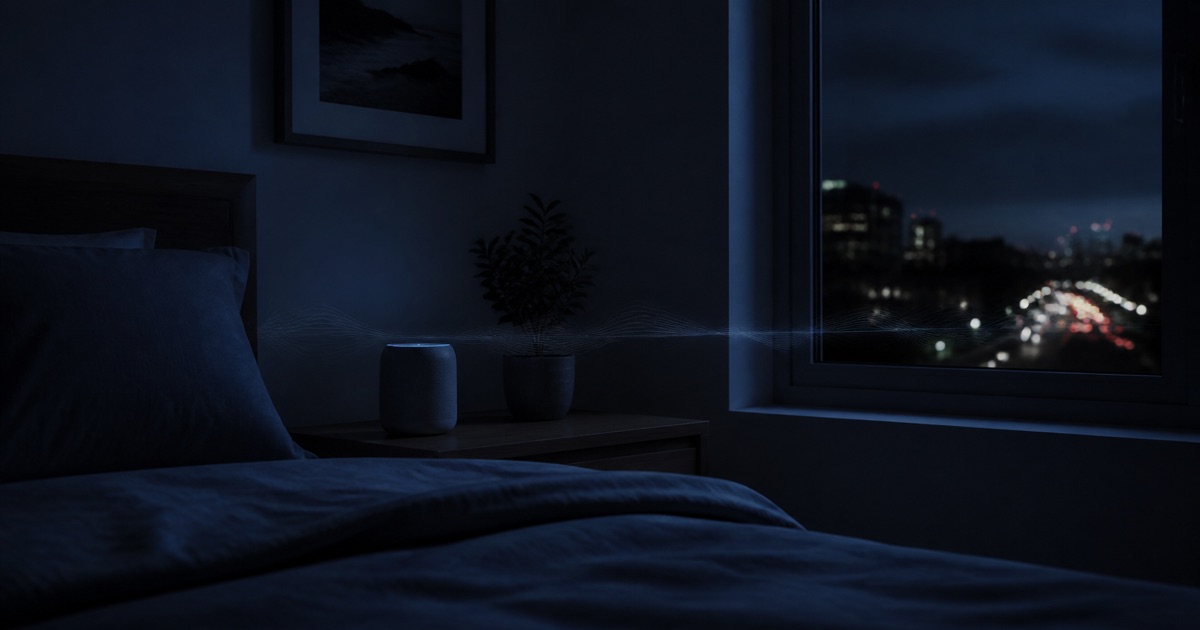
The most defensible mechanism is masking. Your brain notices changes. A car passing through silence creates a large contrast; the same car against a soft, steady background creates a smaller one. The sound has not removed the car, but it may make the change less attention-grabbing.
A second plausible benefit is routine. If you start the same unobtrusive sound as you dim the lights each night, it can become part of a learned bedtime sequence. That is a practical cue, not proof that a specific frequency changes sleep stages.
A third effect is attentional. Some people find a neutral wash less engaging than inner chatter. Others become more aware of the loop or hiss. The direction depends on the listener.
What does the evidence actually show?
Research on continuous sleep noise is mixed, and its overall quality is very low. A 2021 systematic review examined continuous white noise and similar broadband sounds. Findings ranged from improvement to disruption, while studies differed substantially in sound, setting, duration, and how sleep was measured.
Another systematic review concluded that the effectiveness of white and pink noise was not well established. That is a long way from “proven not to work,” but it is also a long way from a reliable sleep intervention.
The honest conclusion is narrow: masking may help some people in noisy environments; personal preference matters; and current studies do not justify universal promises. Sound should not be used to cover warning signals or important alarms.
How can you run a useful test?
Avoid judging from one unusually good or bad night. Use a small comparison:
- Choose one steady sound. Avoid tracks with sudden thunder, bird calls, or obvious volume changes.
- Set the lowest useful volume. It should soften outside noise, not dominate the bedroom. See how loud sleep sounds should be.
- Keep other conditions stable. Use roughly the same bedtime and room setup for three to seven nights.
- Record three observations each morning. Note estimated time to fall asleep, remembered awakenings, and how rested you feel.
- Compare with silence. Try several otherwise similar nights without sound.
Keep the sound if the pattern is clearly better and it remains comfortable. Change the sound, use a timer, or return to silence if the benefit is absent. This kind of modest experiment is more useful than chasing claims about a perfect frequency.