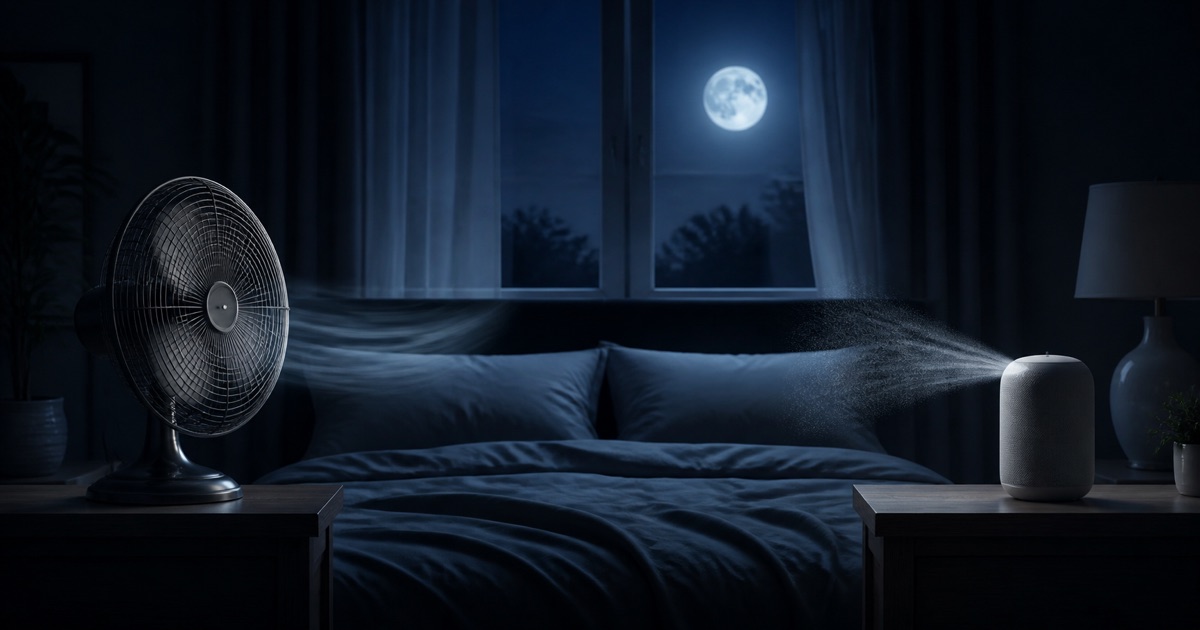
A fan solves two problems at once, which is either its greatest strength or the reason it is the wrong tool. You get sound and moving air together. A white-noise track gives you independent control of the sound.
The right choice therefore depends less on sleep folklore and more on the room.
What does a fan do better?
A fan provides a naturally continuous sound without an audio loop. Its motor and moving air create a stable background that can soften voices, doors, or traffic. Many people already associate that sound with bedtime, so it can fit a routine without needing an app or connection.
Air movement may also make a warm room more comfortable. But if the room is already cool, the draft bothers you, or the fan dries your eyes or throat, sound and airflow become a poor bundle. A wobble, bearing noise, or oscillating change in loudness can also be more distracting than silence.
What does white noise do better?
A white-noise speaker lets you control sound without changing airflow. You can adjust its level, placement, timer, and often its frequency balance. White noise’s brighter spectrum can be useful for making speech details or high-pitched sounds less distinct.
Digital playback introduces its own failure points. Short loops can become obvious, notifications can interrupt, Bluetooth can disconnect, and different tracks are mastered at different levels. Download the track if possible, use do-not-disturb settings, and test the setup while awake.
If white noise feels too hissy, compare white, pink, and brown noise at similar perceived loudness.
Is either proven better for sleep?
No good evidence shows that a fan beats white noise or vice versa. In fact, evidence that continuous broadband noise reliably improves sleep at all is mixed and very low quality. The plausible value is masking, especially in a noisy environment, not a special sleep-inducing property.
That makes personal testing appropriate. It does not make every confident claim equally valid.
How should you compare them?
Try this four-night check:
- Use the fan for two nights. Pick the lowest speed that provides enough sound and comfortable airflow.
- Use white noise for two nights. Put the speaker in a similar location and match the perceived loudness, not the device percentage.
- Keep the rest stable. Avoid changing bedtime, window position, and bedding during the comparison.
- Score the morning. Note noise-related awakenings, comfort, and whether the masker itself drew attention.
Choose the quieter, less noticeable tool. A fan wins if it improves both sound and temperature. White noise wins if you need masking without airflow or want more precise control. Silence wins if neither produces a consistent benefit.
Whichever you use, do not turn it up until all outside sound disappears. Follow the lowest-effective-volume rule and keep important alarms audible.