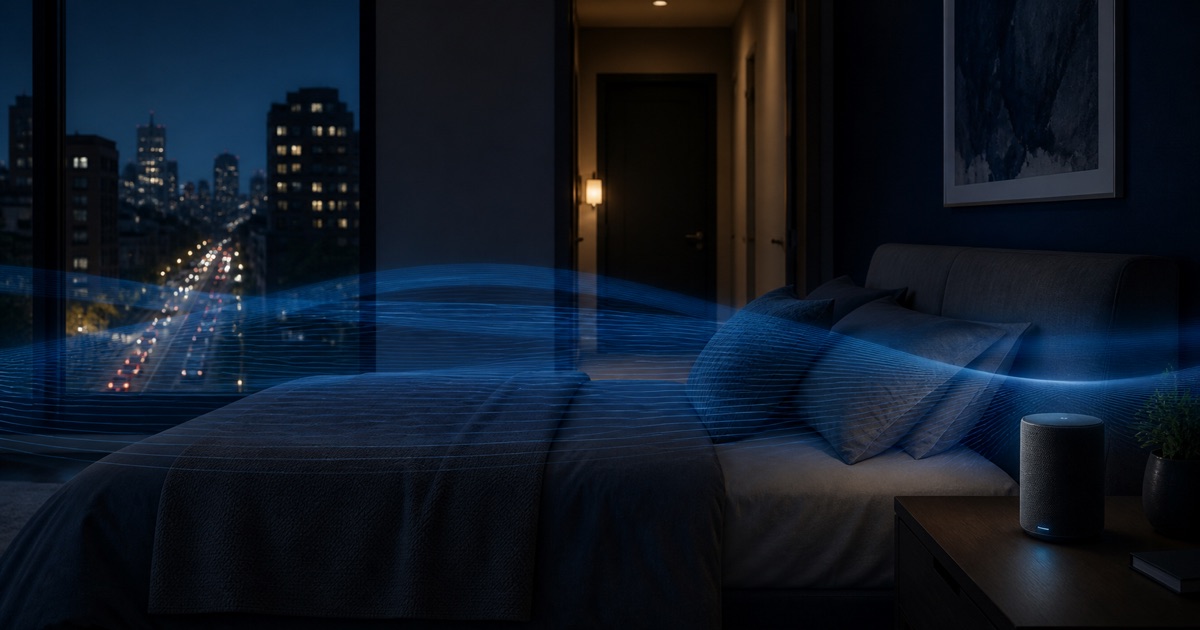
The tempting move in a noisy room is to fight sound with more sound. That can work up to a point, but it can also leave you lying between traffic and an unnecessarily loud speaker.
A better setup uses layers. Every decibel you remove at the source or along its path is one you do not need to add beside the bed.
What should you fix before adding a masking sound?
Start with the source and the path. Close a rattling window, move a buzzing charger, ask for a quieter door close, or put a vibrating device on a padded surface. Then look for air gaps around doors and windows, because airborne sound travels through them easily.
Heavy curtains, a full bookcase against a shared wall, a rug, and soft furnishings can reduce reflections and make sharp noises feel less lively. They will not soundproof a room, especially against deep bass, but modest reductions make masking easier.
If possible, move the bed away from the shared wall, hallway door, or window. Distance is free, and it may let you use a lower playback level.
How does masking work?
Masking makes changes less prominent by creating a steady acoustic background. It is most useful for intermittent sound: speech fragments, doors, plumbing clicks, or passing vehicles. It is not noise cancellation and does not remove the original sound.
Research supports this mechanism more clearly than it supports broad promises of better sleep. Systematic reviews of continuous noise find mixed outcomes and very low-quality evidence overall. That is why the goal is a targeted setup, not a claim that white noise helps everyone.
How do you build a three-layer setup?
- Reduce: quiet or move anything you control, including device alerts, loose vents, and vibrating objects.
- Block: close gaps, use curtains or a door sweep where appropriate, and move the bed farther from the disturbance.
- Mask: place a fan or speaker between the bed and the remaining noise, then start at the lowest volume.
- Match: use white or pink noise for sharper sounds; try brown noise or a low fan for rumble. These are practical starting points, not universal rules.
- Protect: confirm that alarms and important signals remain audible. Never use masking to hide a sound that needs investigation.
For voices, the goal is often to reduce intelligibility rather than make the voice vanish. For low bass, turning up a bright white-noise track may add irritation without covering the vibration. Structural changes or moving rooms may be more effective.
How do you tell whether the setup works?
Keep one arrangement for several typical nights. Each morning, note remembered noise-related awakenings and how rested you feel. Then compare it with a lower volume or a timer. The research is too mixed to assume more sound is better.
If choosing between common maskers, compare a fan with white noise. If the room remains disruptive despite reasonable changes, discuss the source with the property manager, household, or an acoustic professional rather than continuing to raise the volume.